

Backcountry Alternative for Durable Electronics
Table of Contents
- Why a Backcountry Alternative for Durable Electronics Makes Sense
- What to Look for in Durable Outdoor Electronics
- Power Banks and Charging Stations Compared
- Choosing a Satellite Messenger for Backcountry Safety
- GPS Devices for Hiking and Navigation Tools
- Electronics for Thru-hiking and Multi-Day Trips
- Total Cost of Ownership and Retailer Comparison
- Conclusion
- Frequently Asked Questions
Last Updated: October 21, 2026
Why a Backcountry Alternative for Durable Electronics Makes Sense
The outdoor electronics aisle has a problem, and it is not selection. It is trust. Walk into any large gear retailer and you will find rows of power banks and GPS units with glossy packaging and vague claims. What you will not find is a straight answer about how the thing survives a wet week in the alpine or a dropped pack on granite. That gap is exactly why a backcountry alternative for durable electronics matters: you want gear chosen for field use, not for shelf appeal.
Summit Pro Gear approaches this differently. We stock outdoor electronics with published specs, real capacity numbers, and honest limits, so you can compare before you commit. Below, we break down what durability actually means, how to read environmental ratings, and which devices earn their place in a pack.
What to Look for in Durable Outdoor Electronics
Durable outdoor electronics are devices built to keep working through cold, moisture, vibration, and rough handling, with published ratings you can verify. The three specs that matter most are ingress protection, operating temperature range, and battery chemistry.
A common mistake is shopping by capacity alone. A 70,000mAh lantern is useless if its ports fail after one season. Check these instead:
- IP rating: IPX3 handles rain spray, not immersion. Know the difference before you trust it near water.
- Operating temperature: Many power stations list -10 to 40°C. Below that, lithium cells lose output fast.
- Battery chemistry: LiFePO4 cells are rated for thousands of charge cycles, which matters if you recharge weekly.
- Port protection: Sealed covers and recessed ports survive grit better than exposed slots.
Durability Testing and Environmental Ratings
No universal test standard covers camping electronics, so treat ratings as floors, not guarantees. An IP rating tells you what a lab splash test showed, not what happens when a device sits in a soggy pack for three days. Ask two questions: does the manufacturer publish an operating temperature range, and does it publish cycle life? If either is missing, assume the worst.
Power Banks and Charging Stations Compared
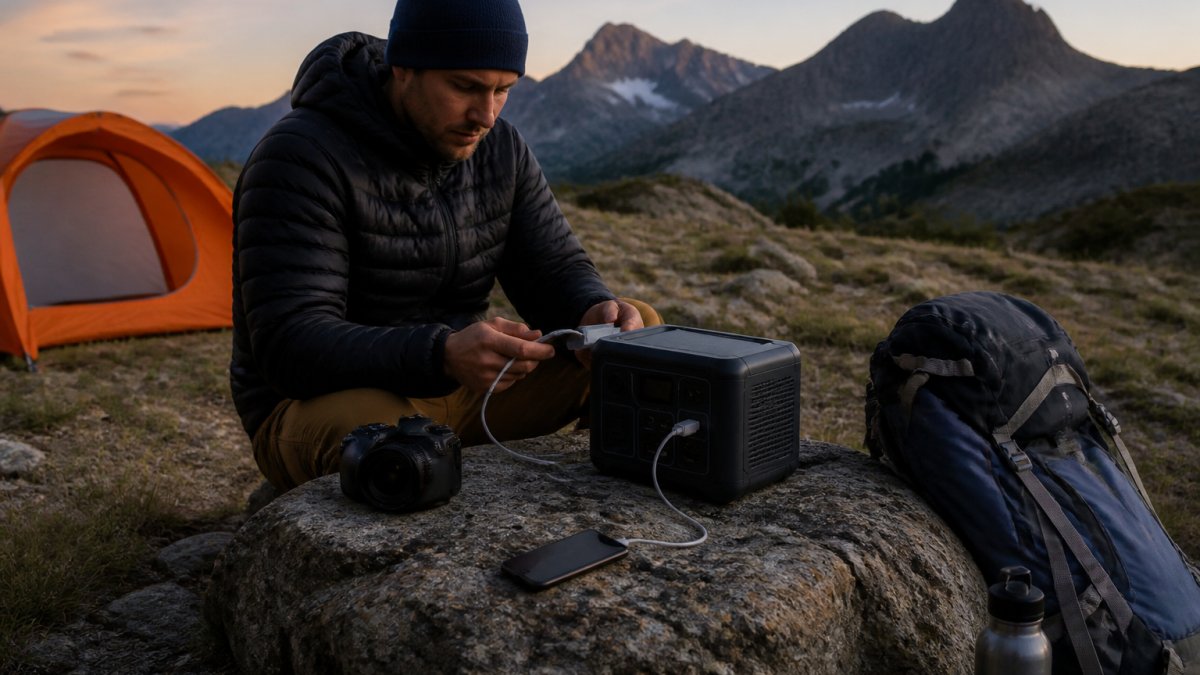
Portable power stations split into three tiers by capacity and weight, and the right pick depends on trip length rather than budget. A weekend camper needs far less than a remote worker running a laptop for a week.
| Device | Capacity | Best For | Weight | Price |
|---|---|---|---|---|
| GaiaRay 500W Portable Power Station | 460.8Wh LiFePO4 | Weekend basecamps, laptops and cameras | ≈5.36kg | $309.99 |
| IEE P800 Solar Generator | 512Wh LiFePO4 | Quiet camp power, mini fridges | 6kg | $351.99 |
| EcoFlow Delta 3 | 1024Wh LiFePO4 | Van life, remote work, outages | Not listed | $766.99 |
| LED Camping Lantern 70000mAh | 259.74Wh | Tent lighting plus phone top-ups | ≈1410g | $121.99 |
The GaiaRay earns its place for pure sine wave output, which keeps laptops and cameras safe from dirty power. The IEE P800 runs below 20 decibels, so it will not ruin a quiet site. The Delta 3 is the pick for anyone working remotely: 1800W across 15 ports and an 80-minute wall recharge.

Choosing a Satellite Messenger for Backcountry Safety
A satellite messenger is a two-way communication device that sends texts and SOS alerts beyond cell coverage.
We do not stock satellite messengers, so here is how to judge them on the criteria that actually separate the field.
Network, not brand. Satellite messengers ride on one of two constellations: Iridium (used by Garmin inReach and some ZOLEO models) or Globalstar (used by some Apple and SPOT devices). Iridium advertises true global pole-to-pole coverage; Globalstar and geostationary systems can have gaps at high latitudes and in deep valleys.
Two-way vs. one-way. A one-way device (like a classic SPOT) can send a preset "I'm OK" or SOS but cannot receive a reply. A two-way messenger lets you explain the situation, receive weather updates, and coordinate with rescuers.
Subscription structure. This is where the real cost hides. Most messengers require an annual or monthly plan, and the SOS response itself is usually free, but messaging, tracking, and weather add-ons are billed. Compare:
- Activation and annual fees: Some plans charge a yearly activation fee on top of the monthly rate.
- Message allowances: Plans often include a set number of texts, then charge per message.
- Suspension options: If you only travel a few months a year, a plan you can pause saves more than a cheaper monthly rate.
- SOS cost: Confirm the emergency response center is included, not billed per incident.
SOS response center. The device routes your alert to a rescue coordination center, which then contacts local authorities. Ask which center the brand uses and whether it operates 24/7 in your region.
Battery and field behavior. Messengers are typically rated in days of battery life with tracking on, not standby. Cold drains them faster. Look for a device that charges over USB-C, has a physical SOS button that cannot be triggered accidentally in a pack, and shows a clear send confirmation on screen.
Pair it with a low-tech backup. A NOAA weather radio guidance approach still works when batteries and screens fail, and our Solar Hand Crank NOAA Weather Radio at $29.99 covers AM, FM, and weather bands with three recharge methods.

GPS Devices for Hiking and Navigation Tools
GPS devices for hiking should be judged on battery life, offline maps, and screen readability in sunlight, not on feature lists. A phone works until it doesn't; a dedicated unit keeps working when the screen is wet and your hands are cold.
GaiaRay 500W Portable Power Station 4608Wh LiFePO4 Battery Solar Generator →
Carry a compass as backup regardless. Electronics fail, and knowing how to take a bearing is a skill no battery can replace. For navigation planning, USGS topographic map resources remain the reference standard for terrain detail.
For charging navigation gear on multi-day routes, the LED Camping Lantern doubles as a power hub with dual USB-C and dual USB-A outputs, delivering 100W plus 45W combined. It runs lighting for more than 12 hours on a charge, which covers most evening routines.
Electronics for Thru-hiking and Multi-Day Trips
Electronics for thru-hiking follow one rule: every gram must justify itself. On a multi-day trip, weight discipline beats capability, and redundancy beats both.
Build your kit around three functions: power, navigation, and communication. A solar panel paired with a power station covers the first. A dedicated GPS covers the second. A satellite messenger covers the third. Everything else is optional.
The GaiaRay accepts a 15V-20V solar panel up to 90W through its built-in smart controller, which means you can refill capacity off-grid without carrying a wall charger. At roughly 5.36kg it suits basecamp trips better than fastpacking.
Total Cost of Ownership and Retailer Comparison
Total cost of ownership is where cheap electronics lose, but the math only works if you run it. A $30 power bank replaced twice a season costs more than a LiFePO4 station rated for thousands of cycles, and that is before you count the trip ruined by a dead bank.
Run the cycle math. Cycle life is the number of full charge-discharge cycles a battery survives before its usable capacity drops to roughly 80 percent. The IEE P800 is rated for over 3,500 charge cycles, and the EcoFlow Delta 3 for over 3,000. If you recharge weekly through a season, that is years of service from one purchase. A budget bank that degrades after a few hundred cycles may need replacing every season or two. Divide purchase price by rated cycles to get a cost-per-cycle figure, then compare that instead of the sticker.

Count the accessories and subscriptions. The purchase price is rarely the whole cost. Add:
- Solar panels: A power station with solar input needs a panel to refill off-grid; budget for the panel and the cable.
- Replacement batteries: Devices with user-replaceable cells last longer than sealed ones.
- Subscription fees: Satellite messengers and some GPS units bill monthly or annually.
- Warranty coverage: A longer warranty is worth real money if it covers the failure modes you will actually hit.
Compare retailers on the dimensions that matter. Large retailers win on volume and fast shipping. Smaller shops win on advice, spec transparency, and returns handled by people who actually answer. When you compare where to buy durable electronics, check:
- Selection: Does the retailer stock the rugged, rated devices, or only shelf-appeal models?
- Published specs: Are IP ratings, temperature ranges, and cycle life listed on the product page, or buried in a PDF?
- Warranty and returns: Who handles a warranty claim, the retailer or the manufacturer, and how long is the return window?
- Shipping: Does the retailer ship batteries and power stations under the hazardous-materials rules that apply to lithium cells?
- Specialist support: Can you talk to someone who has used the device before you buy?
We publish full specs on every listing for exactly this reason, and our team will talk through a trip before you buy. That is the difference between a retailer that sells electronics and one that helps you choose them.
Conclusion
The hard part of buying durable electronics is not finding options. It is finding specs you can trust before the trip, not after the failure. That is the gap we built Summit Pro Gear to close, with published capacity and cycle ratings, fast and friendly service, and a catalog that covers camping, hiking, and outdoor electronics in one order. Shop Summit Pro Gear and gear up with electronics you can actually verify.
Frequently Asked Questions
What are the best alternatives to Backcountry for outdoor electronics?
Specialist outdoor retailers such as Summit Pro Gear stock the same categories of durable electronics: portable power stations, rechargeable lanterns, weather radios and navigation accessories. The key is checking the specs that matter in the field, such as LiFePO4 battery chemistry, pure sine wave output and charge cycle ratings, rather than relying on brand reputation alone. Comparing those figures side by side gives you a clearer picture of which retailer actually carries gear built to last.
Are satellite messengers worth carrying in the backcountry?
For anyone heading off the beaten path where mobile signal drops, a satellite messenger for backcountry trips adds a layer of safety that a phone cannot match. It lets you send an SOS and check in with family even without coverage. They are not a substitute for a map and compass, but they shorten the gap between an emergency and rescue. If you hike solo or in remote terrain regularly, the peace of mind is worth the weight.
How do I choose electronics that can withstand outdoor conditions?
Start with the environmental ratings. Look for operating temperature ranges, water resistance ratings and battery chemistry. LiFePO4 cells, for example, hold up over thousands of charge cycles and handle cold better than older lithium-ion packs. Check whether the housing is sealed against dust and splashes, and whether the device has protective functions like over-temperature and short-circuit cutoffs. Those details separate gear that survives a season from gear that survives a decade.
What should I look for in a durable GPS or satellite messenger?
Prioritise battery life, weight and how the device behaves in cold or wet weather. A GPS device for hiking should last multiple days on one charge and have a screen readable in bright sunlight. For satellite messengers, check coverage, SOS response times and whether there is a monthly subscription. Also look at the buttons: gloves-friendly controls matter more than touchscreens when your hands are cold and wet.
What electronics are essential for backcountry hiking?
Most hikers carry a phone, a headlamp or lantern, a power bank and a navigation tool. A satellite messenger is worth adding for remote routes. A compact weather radio is useful in areas prone to sudden storms. Keep the kit light: a 460Wh power station is overkill for a weekend, but a 2000mAh hand-crank radio or a 259Wh lantern covers most needs. Match the capacity to trip length rather than buying the biggest option.