

Buy High Quality Hiking Equipment Online: 2026 Guide
Table of Contents
- Buy High Quality Hiking Equipment Online: What Actually Matters
- Your Hiking Equipment Checklist: What to Buy and in What Order
- How to Choose Hiking Boots Online Without Getting the Size Wrong
- How to Assess Quality and Durability Before You Click Buy
- Should You Buy Used Hiking Gear? Risks, Rewards, and What to Check
- Where to Find Discount Outdoor Gear Without Sacrificing Quality
- Matching Your Hiking Equipment to Your Trip and Skill Level
- Frequently Asked Questions
Last Updated: October 14, 2026
Buy High Quality Hiking Equipment Online: What Actually Matters
Buying high quality hiking equipment online comes down to three things: knowing which categories matter most, checking the specifications that predict durability, and understanding the retailer's return policy before you pay.
At Summit Pro Gear, we have years of industry experience. The happiest customers plan their purchases in order rather than buying whatever looked good first.
Below, we'll show you how to build a kit that lasts, what to check before you click buy, and where to find genuine value on discount outdoor gear.
Your Hiking Equipment Checklist: What to Buy and in What Order
A practical hiking equipment checklist follows a simple priority order: footwear first, then your pack, then shelter and sleep systems, then clothing layers, and finally cookware and small accessories. Buying in that sequence means every later purchase fits the system you've already built.
Here's the order we recommend, and why it matters:
- Footwear and hiking boots. Everything else depends on your feet being comfortable. Get this wrong and no pack will save the trip.
- Backpacks and daypacks. Match capacity to trip length: a daypack for single days, 40-60 litres for overnighters.
- Tents and shelter. Choose by season rating and packed weight, not by floor area alone.
- Sleeping bags and sleep systems. Temperature rating is the number that matters, and it should be conservative.
- Hiking clothing and layers. A base layer, a mid layer, and a waterproof shell covers most three-season conditions.
- Cookware and food preparation. Keep it minimal. One pot and one stove handle most trips.
- Trail essentials. Headlamp, first aid, navigation, and repair kit.
| Priority | Category | Buy This First If... | Typical Budget Share |
|---|---|---|---|
| 1 | Footwear | You hike more than once a month | Highest |
| 2 | Backpack | You carry more than 5 kg | High |
| 3 | Shelter | You camp overnight | High |
| 4 | Sleep system | You camp in shoulder seasons | Medium |
| 5 | Clothing layers | You hike in changeable weather | Medium |
| 6 | Cookware | You cook on trail | Low |
| 7 | Accessories | You have the basics covered | Low |
A common mistake is buying the fun stuff first. Stoves and gadgets are cheap and satisfying, but boots and a pack are what make a trip work.
How to Choose Hiking Boots Online Without Getting the Size Wrong
To choose hiking boots online accurately, measure your feet at the end of the day, add a thumb's width of toe room, and compare that measurement against the specific brand's own size chart rather than your everyday shoe size.
Three things to get right before you order:
- Measure both feet, standing, late in the day. Feet swell during activity, and one foot is usually larger.
- Check the width, not just the length. A boot that's long enough but too narrow will blister on descents.
- Read the return policy before you buy, not after. A generous return window is what makes online boot shopping low-risk.
Boot fit also changes with sock thickness. If you plan to wear thick merino socks in winter, size for those socks, not the thin ones you wear in summer.
How to Assess Quality and Durability Before You Click Buy
Assessing durability online means reading the specification list, not the marketing copy. Look for stated materials, construction methods, weight, and any warranty terms. Those four details tell you more than any product photo.
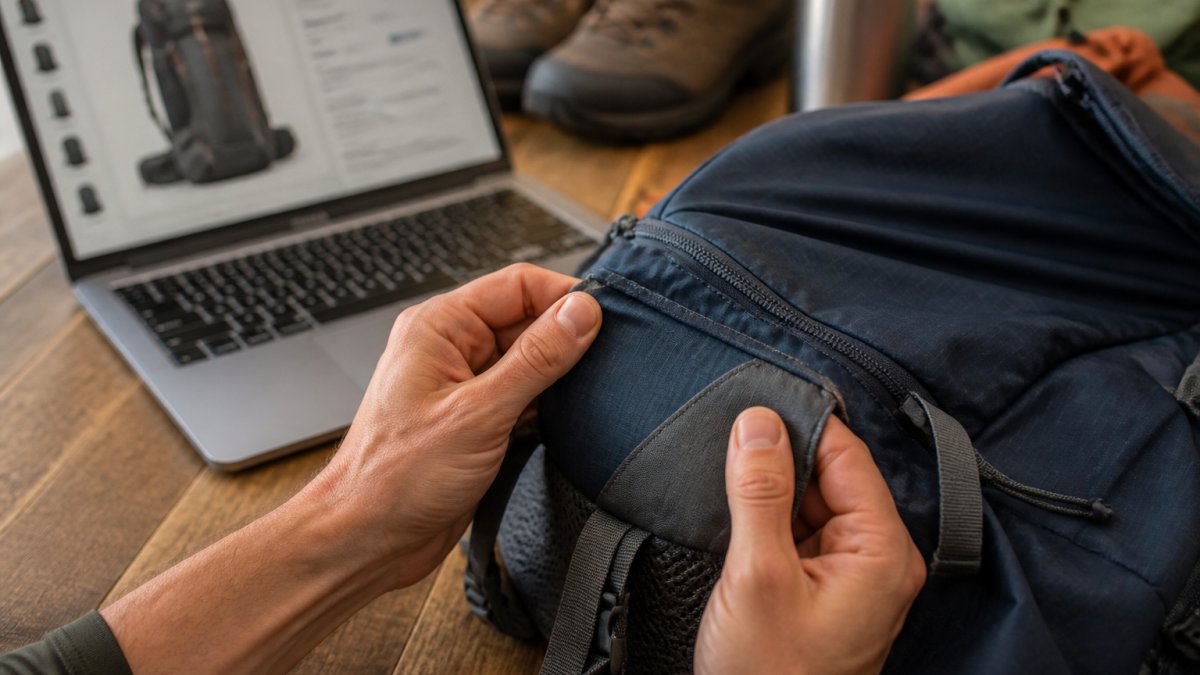
Most gear roundups tell you what to buy; few teach you how to read a product page like a quality inspector. Here's a repeatable method for judging durability from any listing, so you can evaluate any brand.
The four specification signals that predict lifespan
1. Stated materials with a number attached. "Ripstop nylon" is marketing. "210D ripstop nylon" is a specification.
2. Construction methods you can verify. Look for specific, checkable claims:
- Packs: bar-tacked or double-stitched strap anchors, YKK zippers (a named component brand), and a hip belt that transfers load to your pelvis rather than hanging from your shoulders.
- Tents: a hydrostatic head rating for both fly and floor (measured in millimetres, 1,500 mm handles light rain, 3,000 mm plus handles sustained storms), aluminium alloy poles rather than fibreglass, and taped or sealed seams stated explicitly.
- Sleeping bags: a temperature rating tied to a recognised standard (EN 13537 or ISO 23537), fill disclosed by weight and fill power (e.g. "800-fill down, 400 g"), and a shell fabric with a stated denier.
3. Weight as a quality clue. Weigh the claimed weight against the category norm. A four-season tent claiming 1.2 kg is either using exotic materials (and should say so) or overstating its weather protection.
4. Warranty terms and repairability. Read the actual terms: how long, what's covered (defects vs. wear and tear), who pays shipping, and whether it transfers on resale.
How to calculate real cost per trip
The sticker price is not the cost. Compare listings by cost per trip, not price tags.
A quick pre-purchase checklist
Before you click buy on any significant piece of gear, confirm the listing answers these questions:
- What is the fabric or material, with a number (denier, fill power, hydrostatic head)?
- What are the named components (zippers, poles, membranes)?
- What does the warranty actually cover, and who pays shipping?
- Are replacement parts available for the parts that wear out first?
- Does the weight make sense for the stated materials and category?
If a listing can't answer three or more of these, that's your answer. Move on.
The REI's guide to gear care and repair approach to maintenance is worth borrowing even if you shop elsewhere: gear that's cleaned and stored properly lasts noticeably longer, which lowers your real cost per trip. For guidance on materials and outdoor safety standards, the American Hiking Society's trail resources is a useful reference point.
Should You Buy Used Hiking Gear? Risks, Rewards, and What to Check
Buy used hiking gear when the item has no safety-critical wear: packs, cookware, and clothing are usually safe buys. Avoid used footwear, helmets, and anything with a load-bearing lifespan you can't verify.
Pre-owned gear stretches a budget further, and well-made equipment often outlasts its first owner. The risks sit in a few specific places:
- Footwear. Midsoles break down with age even when the uppers look fine, so a used boot can fail early.
- Sleeping bags. Loft is hard to judge from photos, and a compressed bag may no longer hold its rating.
- Tents. Check for UV damage, missing pegs, and whether the seam sealing is original or repaired.
For everything else, ask three questions: how many seasons was it used, is the original warranty transferable, and are all the parts included. If the seller can't answer, treat it as a project rather than a purchase.
Naturehike Light Durable Hiking Backpack with Rain Cover →
Where to Find Discount Outdoor Gear Without Sacrificing Quality
Discount outdoor gear is worth buying when the discount comes from end-of-season stock, last year's colourway, or a bundle, not a downgraded specification. The product is the same; only the timing or packaging changed.
But finding a discount is only half the job. The other half, the part almost no gear guide covers, is making sure the purchase is safe, the return policy protects you, and the total landed cost is lower than buying locally.
Three reliable ways to save
- Shop the shoulder seasons. Retailers clear three-season stock as winter lines arrive. Late summer and early autumn are peak clearance windows for tents, sleeping bags, and packs.
- Buy bundles rather than single items. A pack with a rain cover included usually costs less than buying both separately, and the cover is guaranteed to fit.
- Watch for outlet and clearance sections. These are often previous-season models with identical construction. The only difference is the colourway or a minor cosmetic update.
How to evaluate an online retailer before you buy
Before you enter payment details with any online outdoor retailer, check these five things:

1. Return policy, the actual terms, not the headline. "30-day returns" sounds generous until you read that returns must be unworn, in original packaging, with tags attached, and that you pay return shipping. For footwear especially, you need a policy that lets you walk around indoors, or better, on a treadmill, to test fit. Look for: return window length, who pays return shipping, whether returns are accepted for fit reasons or only defects, and whether refunds are cash or store credit.
2. Shipping cost and delivery time. A $10 discount on a $60 item is wiped out by $15 shipping.
3. Seller legitimacy signals. Look for a physical business address (not just a PO box), a working phone number, a privacy policy, and a terms-of-service page.
4. Warranty handling. If the product has a manufacturer's warranty, does the retailer handle claims or push you to the manufacturer?
5. Customer support responsiveness. Send a pre-sales question about sizing, materials, or shipping, and time the response.
The total-cost comparison most buyers skip
When you compare two listings for the same item, compare these numbers, not just the price:
| Cost factor | What to check |
|---|---|
| Item price | Sticker price |
| Shipping | Free threshold? Flat rate? |
| Return shipping | Who pays if it doesn't fit? |
| Duties/taxes | International orders only |
| Warranty shipping | Who pays to send a defective item back? |
| Your time | How long does a return actually take? |
The cheapest listing is rarely the cheapest purchase.
Where our own gear fits
Our own Naturehike Light Durable Hiking Backpack with Rain Cover at $35.99 is a good example of value done properly: waterproof nylon construction, adjustable shoulder straps that shift load away from pressure points, and a foldable strap design that collapses the profile when you're not carrying much.
For longer trips, the Naturehike Large Capacity Outdoor Hiking Backpack at $142.99 holds five days of gear in a 55 to 60 litre volume, with a rain cover integrated into the design. And if you need maximum capacity for multi-season travel, the Naturehike Outdoor Waterproof 60 Plus 5L Hiking Travel Backpack at $157.99 uses durable nylon that resists tears and abrasion on rough ground.


Matching Your Hiking Equipment to Your Trip and Skill Level
Matching gear to your trip is the step most buyers skip, and it saves the most money.
Use this framework:
- Day walks, summer: daypack, trail shoes, one shell layer, water and snacks.
- Day walks, winter: larger daypack, boots, insulation layer, headlamp, emergency shelter.
- Overnight, three-season: 40-60 litre pack, tent, sleeping system, stove, full layering.
Skill level changes the list too.
For a two-person three-season setup, the Naturehike Mongar PRO Ultralight Two Person Tent at $250.99 is a sound benchmark: sealed nylon floor with a waterproof index above 3000 mm, aluminium alloy poles for stability without the weight of fibreglass, and a dual-layer design that separates the breathable inner from the rain fly to manage condensation.
Budget planning follows from the same logic. The National Park Service guidance on trip planning and safety is a useful reminder that preparation matters more than gear volume.
Buying high quality hiking equipment online is easier when you have a retailer that tells you exactly what you're getting and stands behind it.
Frequently Asked Questions
Where is the best place to buy hiking gear online?
Look for retailers that provide detailed product specifications, real customer reviews, and clear return policies. Summit Pro Gear offers a curated selection of hiking equipment with fast shipping and friendly customer service. Check whether the retailer lists materials, weight, and waterproof ratings so you can compare options accurately. A store that explains what each product is designed for saves you from guessing.
How can I tell if hiking equipment is good quality?
Check the materials and construction details. For backpacks, look for durable nylon and sealed seams. For tents, a waterproof rating above 3000 mm on the floor means reliable storm protection. Aluminum alloy poles save weight without losing stability. Read customer reviews that mention long-term use, and check whether the product listing confirms it meets industry quality control standards.
Is it safe to buy used hiking gear online?
Yes, if you inspect carefully. Ask for photos of wear points: sole tread on boots, zipper function on backpacks, and pole integrity on tents. Avoid used items where the structural components look compromised. Used gear works well for low-cost entry into the hobby, but buy new for anything safety-critical like climbing hardware. Always check the seller's return policy before committing.
How can I find discounts on quality hiking equipment?
Watch for seasonal sales, end-of-season clearances, and outlet sections on retailer sites. Buying last year's model color often saves 20-30% with no performance difference. Sign up for retailer newsletters to get early access to sales. Summit Pro Gear regularly offers value pricing on hiking equipment, so check the sale section before paying full price elsewhere.