

How to Choose Hiking Boots Size That Fits Right
Last Updated: October 28, 2026
Quick Summary
To choose the right hiking boots size, measure both feet in the evening while wearing your hiking socks, then use your larger foot's length in centimetres as the anchor against the brand's own size chart. Your larger foot sets your boot size, and you should always check the brand's chart because lasts vary between brands.
- Measure your feet in the evening, when they're at their largest, using the socks you plan to wear.
- Measure across the ball of your foot while standing, since your foot spreads under body weight.
- Compare measurements to the brand's own size chart, not a generic conversion table.
- A size 9 in one boot can fit like a size 8.5 in another brand.
- Work through fit fixes in order: lacing first, then socks and insoles, then size.
Table of Contents
- How to Measure Feet for Hiking Boots
- Hiking Boot Size vs Shoe Size: Why They Differ
- How Should Hiking Boots Fit?
- How Much Toe Room in Hiking Boots?
- How to Choose Hiking Boots Size: A Step-by-Step Fit Test
- Fit Troubleshooting by Symptom and Foot Shape
- Break-In and Return-Window Guidance for Hiking Boots Size
- Find Your Fit Before Your Next Trip
- Frequently Asked Questions
How to Measure Feet for Hiking Boots
Getting the right hiking boots size starts with a tape measure, not a guess. Your feet change shape under load, and hiking boots must account for that.
The fix is simple: measure first, then fit. Below, we'll show you how to do both, including how to turn your measurements into a size chart comparison.
At-Home Foot Length and Width Measurement
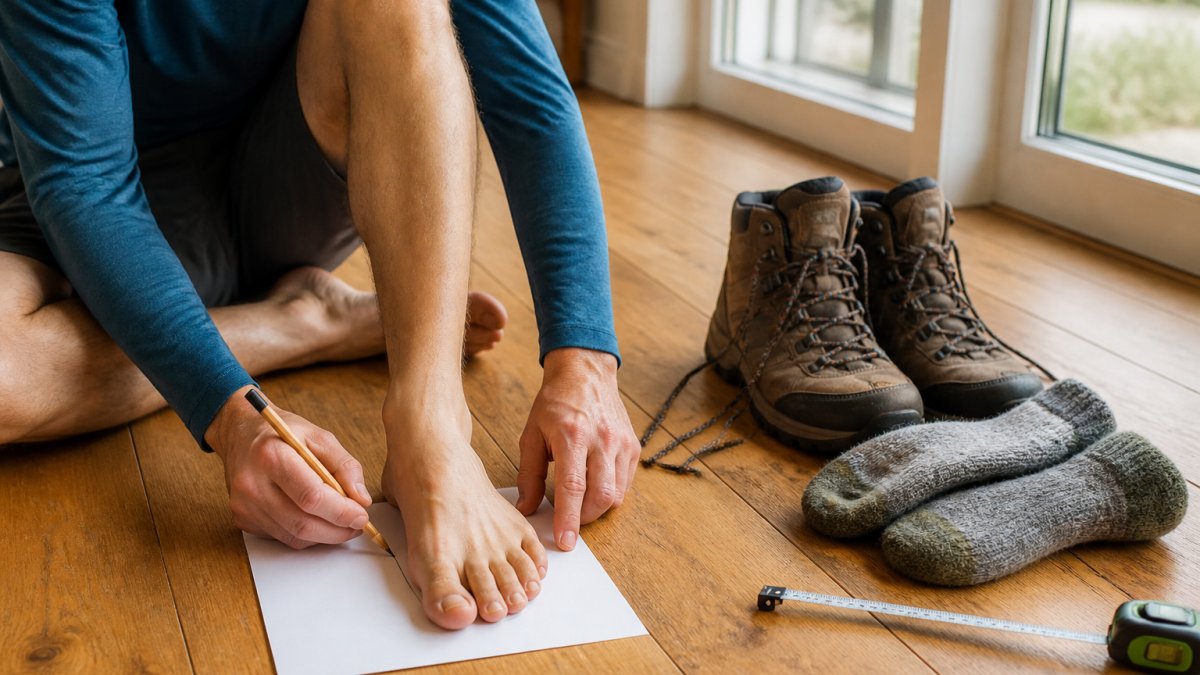
Measure your feet in the evening, when they're at their largest. You'll need a sheet of paper, a pencil, a ruler, and the hiking socks you plan to wear.
- Tape the paper to the floor against a wall.
- Stand on it with your heel touching the wall.
- Mark the tip of your longest toe.
- Measure heel to mark for foot length.
- Measure across the widest part for foot width.
- Repeat for both feet.
Write both numbers down. Your larger foot sets your boot size.
For width, measure across the ball of your foot, the widest part just behind the toes, while standing, since your foot spreads under body weight. Record length in centimetres and width in centimetres or millimetres; most brand size charts use one or the other, and mixing units is a common source of ordering errors.
Turning Measurements Into a Boot Size
Once you have your length and width, compare them to the brand's own size chart, not a generic conversion table. Most hiking boot brands publish a chart that maps foot length in centimetres to their EU, UK, and US sizes. Use the centimetre length as your anchor number, then check the width column if the brand offers narrow, regular, and wide fits.
Accounting for Brand-to-Brand Variation
Shoe lasts vary between brands, so a size 9 in one boot can fit like a size 8.5 in another. Always check the brand's size chart before ordering. Foot length in centimetres is the most reliable number to compare.
Hiking Boot Size vs Shoe Size: Why They Differ
Shoe lasts vary between brands, so a size 9 in one boot can fit like a size 8.5 in another. Always check the brand's size chart before ordering. Foot length in centimetres is the most reliable number to compare.
For context on how footwear should support the foot during activity, the American Podiatric Medical Association footwear guidance is a useful reference.
How Should Hiking Boots Fit?
A good fit gives you three things: heel hold, midfoot support, and toe room. Miss any one of these and you'll feel it on the descent.
Heel Hold, Snug Fit, and Pressure Points
Run your fingers along the inside of the boot. Any spot that presses hard is a pressure point. Those become hot spots within a few kilometres. Try a different lacing pattern before you size up.
How Much Toe Room in Hiking Boots?
A wider toe box suits most foot shapes better than a narrow one. If you have bunions or a wide forefoot, look for boots built with extra width.
How to Choose Hiking Boots Size: A Step-by-Step Fit Test
| Step | Action | What to Check |
|---|---|---|
| 1 | Try boots on late in the day | Feet at their largest |
| 2 | Wear your hiking socks | Match real trail conditions |
| 3 | Check the larger foot first | Sets your size |
| 4 | Press the toe box | Thumb's width of room |
| 5 | Walk and test the incline | No heel lift, no toe impact |
| 6 | Test the descent | Toes clear the front |
Try Boots On at the End of the Day With Hiking Socks
Walk around for at least five minutes. Stand on a step and drop your heel. If your toes jam into the front, the boot is too short.
Check Both Feet and Test on Inclines and Descents
Test on an incline and a descent. On the incline, your heel should stay down. On the descent, your toes should clear the front. If either fails, adjust the lacing first. Only size up if lacing can't fix it.
Fit Troubleshooting by Symptom and Foot Shape
Match the symptom to the fix before you change size. Half of all fit problems are lacing or sock issues, not sizing. Work through the fixes in order, lacing first, then socks and insoles, then size, because each step is cheaper and faster than returning a boot.
Symptom-to-Cause-to-Fix Map
High arches. Cause: the stock insole doesn't support the arch, so the foot flattens and the fit changes. Fix: swap the stock insole for an orthotic or arch-support insole that matches your foot. Re-check length after the swap, a thicker insole takes up volume and can make a correct-length boot feel short.
Foot Shape Matters as Much as Foot Length
A high-volume foot needs a deeper boot. A low-volume foot needs a snugger one. If you use orthotics, bring them to every fitting. Two feet the same length can need different boots if their volume or arch shape differs, which is why the symptom map above starts with the cause, not the size number.
Break-In and Return-Window Guidance for Hiking Boots Size
Buy from a seller with a clear return policy so you can test the fit properly. Check the Federal Trade Commission guidance on return policies to understand your rights before you order. At Summit Pro Gear, our refund policy explains exactly how returns work if the size isn't right.
Find Your Fit Before Your Next Trip
Nail your boot fit and the rest of your gear list gets easier. Once you know your hiking boots size, you can build the kit around it with confidence.
Start with our guide to the best backpacking gear for weekend trips if you're planning a short adventure. New to the trail? Our essential camping gear for beginners covers the basics without the waste. And when you're ready to buy, you can shop high quality hiking equipment online.
Frequently Asked Questions
How much bigger should you get hiking boots?
Most hikers should size up by about half a size from their everyday shoe size, and sometimes a full size if they have wide feet or plan long-distance hiking with thicker socks. The extra room accounts for foot swelling during activity and gives your toes space to move on descents. Always confirm with a proper measurement and a try-on at the end of the day rather than guessing from your shoe size alone.
Is your hiking boot size the same as your shoe size?
Not always. Hiking boot size vs shoe size can differ because boots are built with stiffer materials, different lasts, and room for hiking socks and insoles. A brand's size chart may also run differently from your regular sneakers. Measure your foot length and width, compare against the specific boot's size chart, and treat your shoe size as a starting point, not a guarantee.
How much toe room should there be in hiking boots?
Leave roughly a thumb's width, about 1 to 1.5 centimetres, between your longest toe and the front of the boot. This toe room in hiking boots lets your toes wiggle and prevents toe impact on downhill sections. Check it standing up with your hiking socks on, since feet spread when weight-bearing. If your toes touch the front on a descent, the boot is too short.
Should you try hiking boots on with hiking socks?
Yes. Bring the hiking socks you plan to wear, since sock thickness changes how a boot fits. Try boots on at the end of the day when feet are naturally swollen, lace them up, and walk around on an incline and a descent if possible. Check both feet, because one is often slightly larger. This fit test catches pressure points and heel lift before you commit.
Getting the fit right changes everything about your time on the trail. At Summit Pro Gear, we stock a wide range of hiking boots backed by years of industry experience and a fast, friendly customer service team. Our quality, variety, and value promise means you can shop smart and find the perfect pair for your next journey. Get started with Summit Pro Gear and hike in comfort from the first step.
